
Can you earn money from Facebook Reels, videos, photos, and even text posts?
Yes, Facebook has a program that lets eligible creators earn from different types of content. It is called Facebook Content Monetization.
But there is a catch.
Not every Facebook Page can join. Getting views does not mean every view will earn money. And using someone else’s viral video can put your monetization at risk.
So, how does the program work? Who can join? And what should you do if the option is missing from your dashboard?
This guide explains Facebook Content Monetization in 2026, including eligibility, invitations, earnings, supported content, and Meta’s rules for original content.
Whether you live in Pakistan, India, Bangladesh, the UAE, or another country, you’ll learn what to check before trying to monetize your content.
What Is Facebook Content Monetization?
Facebook Content Monetization is a program from Meta that lets eligible Facebook creators earn money based on the performance of qualifying content.
Meta introduced the program in October 2024 to bring three earlier monetization programs together:
- In-stream Ads
- Ads on Reels
- Performance Bonus
Instead of managing those programs separately, eligible creators can use one broader monetization system.
The program supports several content types, not just videos.
However, Facebook Content Monetization is still invite-only as of November 2026. Having a Facebook Page or publishing content does not guarantee access.
Official source: Meta — Introduction to Facebook Content Monetization
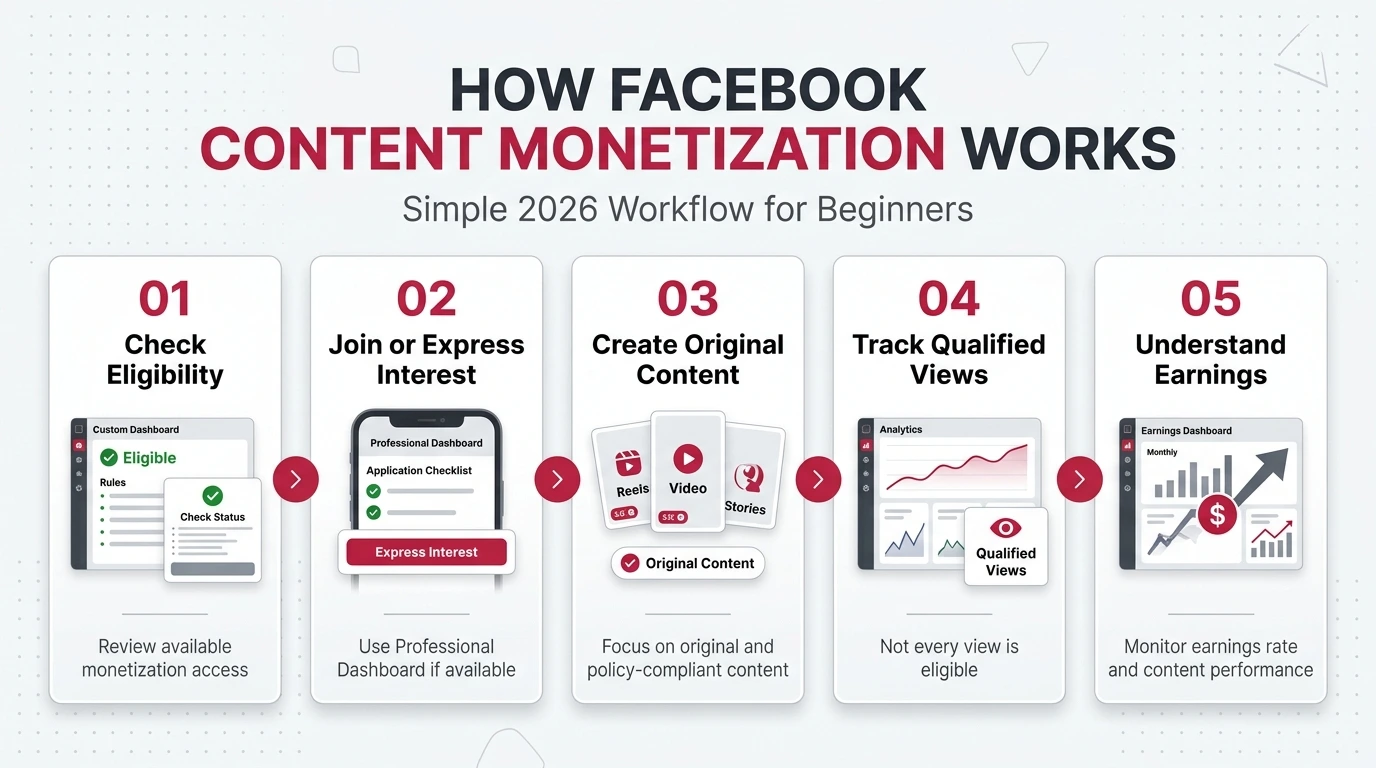
How Does Facebook Content Monetization Work?
Let’s use a simple example.
Imagine you manage a Facebook Page about home cooking.
You create your own recipe videos, take original food photos, and publish useful cooking tips.
People watch your Reels, share your photos, and engage with your posts.
If your Page has access to Facebook Content Monetization, Meta may reward qualifying content based on its performance.
However, not every view counts toward earnings.
Meta considers factors such as eligible views, originality, engagement, and other program rules.
That means two videos with the same total views may earn different amounts.
The key lesson: Build content that people want to watch. Don’t assume views alone will produce a fixed payment.
Are you know about: How to Start TikTok Automation in Pakistan (2026) – Beginner’s Guide
What Types of Facebook Content Can Earn Money?
One useful feature of Facebook Content Monetization is that it covers several formats.
| Content Type | Examples |
|---|---|
| Facebook Reels | Short educational videos, cooking tips, original comedy |
| Longer Videos | Tutorials, lessons, demonstrations |
| Stories | Eligible original Story content |
| Photos | Original photography, useful visual posts |
| Text Posts | Original written posts, tips, explanations |
Meta confirmed that its program pays eligible creators across these formats.
But this does not mean every upload earns money.
The creator, content, and account must meet the program’s requirements.
Can Facebook Reels Earn Money?
Yes. Eligible creators can earn from qualifying Reels.
You could create original tutorials, share practical tips, or tell stories through short videos.
The video should provide real value and follow Meta’s policies.
Simply downloading another creator’s Reel and posting it on your Page is not a safe monetization strategy.
Can Facebook Photos and Text Posts Earn Money?
Yes, the program includes eligible photos and text posts.
For example, a cooking creator might publish original recipe photos. A teacher might share useful written explanations.
Still, don’t treat every image or text post as automatically monetized.
Eligibility and content performance matter.
Facebook Content Monetization Eligibility Requirements in 2026
This is where many beginners get confused.
You may hear that you need a certain number of followers or a fixed number of video views.
Be careful with such claims.
Meta has not provided one universal public follower threshold that guarantees an invitation to Facebook Content Monetization for every creator.
Eligibility can depend on your account, region, policy status, and the program’s current requirements.
Here are the main areas to check.
1. Program Availability
Facebook Content Monetization is not automatically available to every account in every country.
You need to check whether the program is offered to your account and region.
2. Invitation or Program Access
As of November 2026, Facebook Content Monetization remains invite-only.
Meta also lets interested creators submit an interest form through the Professional Dashboard when that option is available.
Submitting interest does not guarantee an invitation.
3. Monetization Policy Compliance
Your Page or professional account must follow Meta’s relevant monetization policies.
Serious or repeated violations can affect access.
4. Original Content
Meta places strong emphasis on original work.
Content you produce yourself, or content with substantial creative value, is a better foundation than copied videos.
5. Account and Payout Requirements
Eligible creators may need to complete account, identity, payment, or tax-related steps provided during onboarding.
The exact requirements can depend on the account and location.
Important: Don’t buy followers, use false identity details, or try to bypass regional restrictions to gain access.
Is Facebook Content Monetization Available in Pakistan, India, and Bangladesh?
This question deserves special attention.
Facebook monetization availability can differ by country, program, and individual account.
A country supporting one Facebook monetization feature does not mean it supports every other feature.
Facebook Content Monetization in Pakistan
If you live in Pakistan, do not assume Facebook Content Monetization is available just because you can create a Facebook Page or use Professional Mode.
The current program availability for your account needs to be checked through Meta.
At the time of this guide, we could not independently verify a complete official country-by-country eligibility list confirming universal access for Pakistan-based accounts.
If Content Monetization is missing, you should not assume there is a reliable shortcut that will make your account eligible.
You can still build original content, grow an audience, and develop useful creator skills.
Facebook Content Monetization in India
Creators in India should check the Facebook Professional Dashboard or Meta Business Suite for the monetization features available to their accounts.
Some published eligibility lists include India, but individual program access still needs to be verified.
An eligible location does not guarantee an invitation.
Facebook Content Monetization in Bangladesh
The same principle applies to Bangladesh.
Creators should check the available monetization tools in their own dashboard rather than rely only on online country lists.
Program access can also change over time.
What About UAE, Saudi Arabia, the UK, USA, and Canada?
If you live in one of these countries, check the eligibility information displayed by Meta for your account.
Your location alone does not prove that you meet every condition.
| Country or Region | What Should You Do? |
|---|---|
| Pakistan | Verify current program availability and account access |
| India | Check country support, invitation, and account eligibility |
| Bangladesh | Check the dashboard and current Meta requirements |
| UAE / Saudi Arabia | Verify country and account requirements |
| UK / USA / Canada | Check invitation status and policy compliance |
| Other countries | Check official eligibility information for your region |
Remember: Your audience’s country and your account’s country are not necessarily the same thing.
A creator living in Pakistan with viewers in the USA should not assume US audience views make the account eligible for a US-only feature.
How to Check Facebook Content Monetization Eligibility
You can check your account through Facebook’s creator tools.
Method 1: Facebook Professional Dashboard
- Open the Facebook mobile app.
- Go to your professional profile or Page’s professional tools.
- Open Professional Dashboard.
- Find Monetization.
- Look for Content Monetization.
- Review any invitation, eligibility message, or interest form shown.
If the interest form is available, follow Meta’s instructions.
If you have been invited, review the terms and onboarding steps carefully.
Method 2: Meta Business Suite
If you manage a Facebook Page, open Meta Business Suite and check its monetization tools.
The interface may differ depending on your account, region, and current Meta updates.
Not all users will see the same options.
What If You Cannot Find Content Monetization?
Don’t panic or create fake accounts.
First, check whether:
- Your account has access to professional tools.
- The program is offered in your region.
- You have any policy or account restrictions.
- An invitation or interest form is available.
- You are checking the correct Page or professional profile.
A missing option does not always mean you have violated a policy.
It may simply mean the feature is not available to your account.
How to Apply for Facebook Content Monetization
Meta’s November 2026 guidance explains how creators can express interest in the program.
The general path is:
Facebook App → Professional Dashboard → Monetization → Content Monetization → Interest Form
Complete the form if the feature appears.
Submitting the form is not the same as joining the program.
If Meta invites you, follow the official onboarding process shown in your account.
Avoid websites or people claiming they can sell guaranteed invitations.
You should never share your password, verification codes, or account recovery details with someone who promises monetization access.
Official source: Meta — Creator Fast Track and Content Monetization Updates
How Much Does Facebook Content Monetization Pay?
There is no single payment rate that applies to every creator, country, and content format.
Your earnings may depend on qualifying views, content performance, and the program’s rules.
Meta introduced clearer performance metrics in 2026 to help creators understand their results.
What Are Qualified Views?
Qualified Views are views that may be eligible to earn money.
For example, suppose a Reel gets 50,000 total views.
That does not mean all 50,000 will qualify for monetization.
Meta may count only some of them as qualified views.
The number shown in your dashboard is what matters.
What Is Earnings Rate?
Earnings Rate is Meta’s approximate earnings per 1,000 qualified views.
It is a performance metric, not a fixed promise.
Let’s look at a simple math example.
Suppose a creator has:
- 20,000 qualified views
- An example Earnings Rate of $0.50 per 1,000 qualified views
The calculation would be:
20,000 ÷ 1,000 × $0.50 = $10
This is only a fictional calculation to explain the formula. It is not a real Facebook payment rate, expected result, or earnings prediction.
Your actual dashboard values may be very different.
What Are Non-Qualified Views?
Non-Qualified Views are views that do not qualify for earnings.
Meta has introduced breakdowns to help creators understand why some views may not count.
If your dashboard shows this information, review it instead of assuming every play should generate revenue.
Does Facebook Pay for Every 1,000 Views?
No fixed payment for every 1,000 total views should be assumed.
A video can receive views without producing the earnings you expect.
Focus on the actual performance information shown in your monetization dashboard.
Facebook Content Monetization Policies: What Creators Must Know
Getting an invitation is only part of the process.
Keeping your content original and following Meta’s rules is just as important.
In March 2026, Meta clarified how it treats original and unoriginal content.
Original Content
Original content includes work you create or produce yourself.
Examples include:
- Filming your own cooking tutorial
- Recording a lesson you teach
- Creating an original comedy scene
- Making a useful demonstration with your own explanations
- Publishing photos you created yourself
Original work helps build a recognizable creator identity.
What Counts as Unoriginal Content?
Meta warns against reposting other people’s work with little meaningful change.
Here are some examples.
| Content Example | Why It Matters |
|---|---|
| Reuploading another creator’s Reel | Duplicated content |
| Adding only borders to a copied video | Minor editing does not add much value |
| Speeding up someone else’s clip | Speed changes alone do not make it original |
| Adding basic captions to copied footage | Usually not enough creative contribution |
| Creating your own filmed tutorial | Original production |
| Adding substantial new reporting or analysis to permitted third-party material | May provide meaningful new value, subject to rights and policies |
A video is not automatically original just because you edited it in CapCut or another tool.
Meta says that creators who repeatedly post unoriginal content may face reduced reach or lose monetization opportunities.
Official source: Meta — Rewarding Original Creators on Facebook
Can You Use AI Videos for Facebook Content Monetization?
AI tools can help with video production.
You might use AI to plan a script, create illustrations, edit footage, or generate captions.
But AI does not automatically make content original or eligible for monetization.
Your work still needs to follow Meta’s rules.
A practical approach is to use AI as an assistant while adding your own research, storytelling, creative decisions, and quality checks.
For example, you could create a science explainer using an original script, your own structure, properly licensed visuals, and carefully checked facts.
That is more useful than automatically reposting hundreds of clips from other channels.
You should also follow Meta’s applicable AI-content disclosure rules, copyright requirements, and other platform policies.
Do not assume every faceless AI video will earn money.
Why Is Facebook Content Monetization Not Eligible?
Seeing a “Not Eligible” message can be frustrating.
But there is no single fix for every account.
Here are several possible causes worth investigating.
1. The Program Is Not Available to Your Account
Meta may not offer the feature to your location or account.
Check the current eligibility information rather than relying on old videos.
2. You Have Not Received an Invitation
The program is invite-only.
Not receiving an invitation is different from being rejected for a policy violation.
3. Your Account Has Policy Restrictions
Review any notices about monetization, account status, or policy violations.
If an appeal option is provided, follow the official process.
4. Your Content Is Mostly Reused
A Page built around copied viral videos may have originality problems.
Review your content strategy and create meaningful original work.
5. Your Account Has Not Completed Onboarding
If you’ve been invited, check whether Meta requires additional account or payment details.
Only submit information through official Meta tools.
Can You Fix a Not Eligible Account?
Sometimes a specific issue can be addressed, such as a correctable policy violation or incomplete onboarding.
Other situations, such as unavailable country support or an invitation that has not been offered, may not have an immediate solution.
Avoid anyone promising guaranteed approval.
How to Start Creating Original Facebook Content: A Beginner Workflow
Even if you don’t have monetization access yet, you can start learning content creation.
Here’s a simple process.
Step 1: Choose One Clear Topic
Pick a niche you understand or genuinely want to research.
Examples include cooking, technology tutorials, educational facts, original storytelling, or personal productivity.
Choose something you can create regularly without copying other creators.
Step 2: Find Real Audience Questions
Look at questions people ask in your niche.
If your topic is smartphone tutorials, people might want to know how to save battery life, manage storage, or protect their accounts.
Answer one clear question per short video.
Step 3: Write an Original Script
Start with a clear opening.
Explain the topic in simple language.
Give the viewer useful information, then end naturally.
Avoid making exaggerated claims just to attract clicks.
Step 4: Prepare Your Visuals
Use your own recordings, original graphics, licensed media, or suitable AI-generated visuals.
Check the rights and terms for any tools or third-party material you use.
Step 5: Edit Your Video
Use a video editor to remove pauses, match visuals with speech, and add readable captions.
Watch the finished video before posting.
Make sure the facts, visuals, and audio are correct.
Step 6: Publish and Review Results
Post the video and check your analytics.
Look at watch time, audience response, and the topics that perform well.
Use those findings to improve future content.
This process won’t guarantee views or monetization. Its purpose is to build useful skills and a better content library.
Facebook Automation vs Facebook Content Monetization
These terms sound similar, but they are not the same.
Facebook automation is a content production workflow. It may involve tools for scripting, editing, captions, and planning.
Facebook Content Monetization is Meta’s earning program for eligible creators.
| Facebook Automation | Facebook Content Monetization |
|---|---|
| A method of creating and managing content | An official Meta monetization program |
| Can use AI and editing tools | Requires program access |
| Does not automatically produce income | May pay for eligible content performance |
| Focuses on production workflows | Focuses on earning eligibility and content performance |
You can learn Facebook automation without being enrolled in Content Monetization.
But automation tools cannot guarantee approval or earnings.
Learn Facebook Automation and Monetization With MentorOnline
Understanding Facebook’s rules is a good start.
The next step is learning how to research content ideas, write original scripts, create videos, edit efficiently, and review performance.
At MentorOnline, we’re preparing additional learning resources covering Facebook content creation, automation workflows, and monetization education.
Until the new course is available, you can explore our existing learning resources at MentorOnline.
We recommend learning the production process first, checking eligibility through Meta, and avoiding unrealistic income promises.
Frequently Asked Questions
1. Is Facebook Content Monetization available to everyone in 2026?
No. Meta says the program is invite-only. Account and regional requirements apply.
2. How do I get invited to Facebook Content Monetization?
Check Professional Dashboard → Monetization → Content Monetization. If Meta provides an interest form, you can submit it. This does not guarantee an invitation.
3. Can I earn from Facebook photos?
Yes, eligible photos are included in the program. You still need program access and qualifying content.
4. Can I earn from Facebook text posts?
Yes, eligible text posts are supported. Not every post automatically earns money.
5. Is Facebook Content Monetization available in Pakistan?
Do not assume universal access. Check current availability and your account’s status through official Meta tools.
6. Can I monetize Facebook content from India or Bangladesh?
Availability and eligibility must be checked for your country and account. Country support alone does not guarantee an invitation.
7. How many followers do I need?
Do not rely on one universal follower count as a guarantee. Check the current requirements shown for the program and your account.
8. Does Facebook pay for every 1,000 views?
No fixed payment per 1,000 total views is guaranteed. Qualified views and performance-based metrics matter.
9. Can copied viral videos earn money?
Reposting content with only small changes can violate Meta’s originality expectations and affect reach or monetization.
10. Can AI-generated videos be monetized?
AI-assisted content is not automatically approved or banned simply because AI was used. Content must meet applicable originality, eligibility, disclosure, and other Meta policies.
11. Does submitting the interest form guarantee approval?
No. Meta has stated that the program remains invite-only.
12. What should I do if Content Monetization is missing?
Check your professional dashboard, account status, regional availability, and official eligibility notices. Avoid fake accounts or third-party approval offers.
Final Thoughts
Facebook Content Monetization gives eligible creators a way to earn from different types of content.
But success starts with understanding the rules.
Check whether your account can access the program. Make original content. Learn how qualified views work. And pay attention to any notices from Meta.
You don’t need to buy expensive tools or chase every viral trend to start learning.
Build your skills, create something useful, and review what works.
For official updates, visit Meta’s Creator Monetization Announcement.
For more creator education and future Facebook training resources, visit MentorOnline.
Last reviewed: November 17, 2026. Meta’s program access, payment rules, and account eligibility may change. Always check official Meta information for your account and country.